

Medical Website Design Company vs. In-House: Which Is Right for Your Practice?

Fida Muhammad
Digital Marketing Expert
Published Nov 27, 2026
Updated Nov 27, 2026

Your practice website is often the first place a new patient meets you. It has to explain your services, earn trust, make booking easy, and protect patient information. Choosing who builds and maintains it matters as much as the design itself.
A medical website design company brings outside expertise and dedicated focus. An in-house team gives you daily control and faster changes. This guide compares the two so you can decide which model fits your practice, budget, and goals.
In a hurry? The short version:
- A medical website design company suits practices that want experienced help without building a full team.
- An in-house team suits larger organizations with steady, high-volume website needs.
- Whichever you choose, check privacy, accessibility, and ongoing maintenance before you sign.
- Your website should answer patient questions clearly and make the next step obvious.
What Is a Medical Website Design Company?
A medical website design company is an outside firm that plans, designs, and often builds websites for healthcare providers. Its team usually includes designers, developers, content writers, and specialists in search and accessibility. Good firms understand how patients search, what they need to see, and how healthcare marketing rules shape what a site can say.
In-House vs. Outside Partner: How Each Works
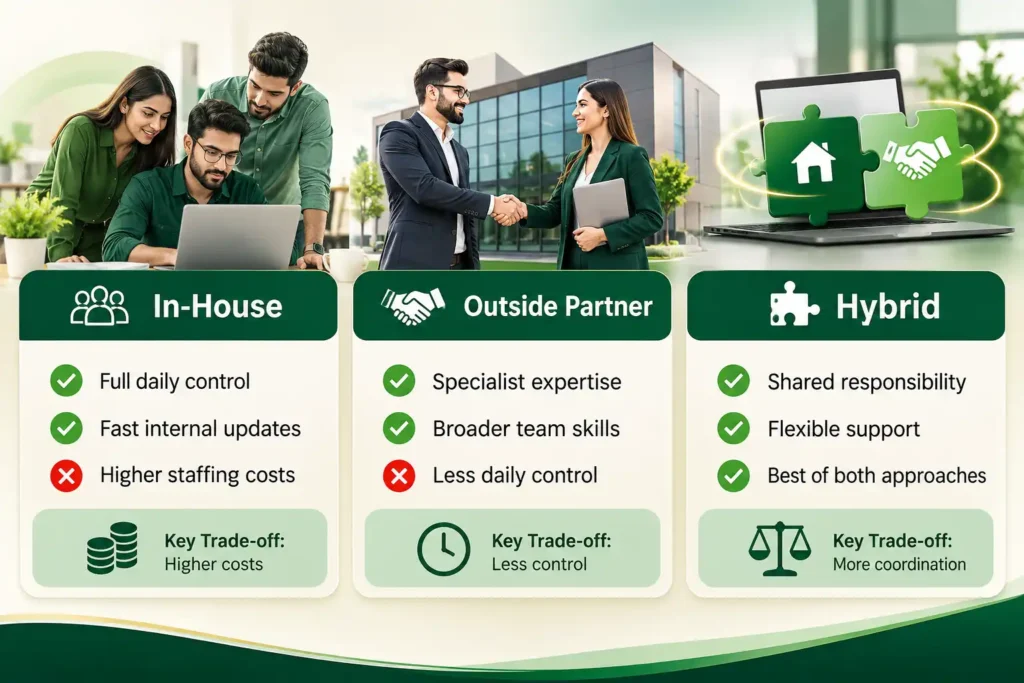
With an in-house team, your staff or a dedicated employee manages the website every day. You control priorities, timing, and direction, and small updates can happen the same day. The tradeoff is cost and capacity. Salaries, tools, and training add up, and one person may not cover design, development, content, and security well.
With an outside partner, you hire specialists for a project or an ongoing retainer. You gain broader skills and a fresh perspective, and you avoid building a full team. The tradeoff is less day-to-day control and the need to manage the relationship well.
Many practices choose a hybrid model. An outside team builds the site and trains staff, then a small in-house person handles routine updates such as hours, providers, and news.
Healthcare Web Development
Healthcare web development covers the technical side of a practice website: the framework, hosting, forms, integrations, performance, and security. It connects the site to the tools a practice already uses, such as scheduling software, electronic health record portals, and patient forms. Strong development makes the site reliable, fast, and easy to maintain.
Healthcare Website Development
Healthcare website development is the full process of turning a plan into a working site. It includes information architecture, page templates, content, testing, launch, and training. Ask any provider to explain each stage and who is responsible for it, since gaps often appear between design and development. A medical website development project should follow the same stages whether an agency or your own team does the work.
Medical website developers should also understand how patients use phones. Most visitors arrive on mobile devices, so the build must work well on small screens from the start.
Medical Website Design Services
Medical website design services usually cover brand direction, page layouts, service pages, provider profiles, appointment and contact forms, and a content plan. Some firms add search optimization, photography coordination, and ongoing maintenance.
A useful service package explains what each page is for. The homepage should state who you serve and how to book. Service pages should explain conditions and treatments in plain language. Provider pages should help patients decide whether they feel comfortable with your team.
Choosing a Healthcare Website Design Agency
When you compare a healthcare website design agency with an in-house option, start with experience. Ask for examples of medical or healthcare sites the agency has built, and check whether those sites are easy to use, fast, and accessible.
Look closely at what each healthcare web design agency includes after launch. Ongoing hosting, updates, security monitoring, and support matter more than the first version of the design.
A healthcare web design company should also be honest about its limits. Ask how it handles privacy, accessibility, and healthcare advertising rules. Clear answers are a good sign. Vague promises are not.
Some practices compare a medical web design company with a larger healthcare website design company that offers broader services. Match the size of the team to your needs, because a small practice rarely needs a large agency structure.
Finally, consider the healthcare web design services that will support you over time. The best partner stays involved after launch to track performance, refresh content, and fix problems quickly.
What a Healthcare Website Development Agency Should Provide
A healthcare website development agency should deliver more than a finished page. Expect these items in writing before you sign:
- A clear project plan with milestones and owners
- Design mockups reviewed by your staff, not only by the agency
- Accessible, mobile-friendly templates that meet recognized accessibility standards
- Training so your team can update content without the agency
- Documented handoff of login access, hosting, domains, and analytics accounts
- Defined support terms for fixes, updates, and security patches
If an agency resists any of these, ask why before you move forward.
Secure Patient Messaging on Your Site
Patients often want to send questions through your website. Secure patient messaging protects the information they share, so treat it as a core requirement, not an extra feature. Use encrypted forms, limit the data collected to what you need, and make clear what patients should and should not include in a message.
Also explain how urgent messages should be handled. A website form is not a substitute for emergency care, so the page should direct urgent situations to the right phone number or emergency service.
Healthcare Responsive Website Basics
A healthcare responsive website adjusts to any screen, from a large desktop monitor to a small phone. Patients often search for a clinic while they are already worried or in a hurry, so the mobile experience matters most.
Check that buttons are easy to tap, text is readable without zooming, forms are short, and phone numbers are clickable. Test the site on real devices, not only in a design tool.
Healthcare Website Design Tips: Essential Features Checklist
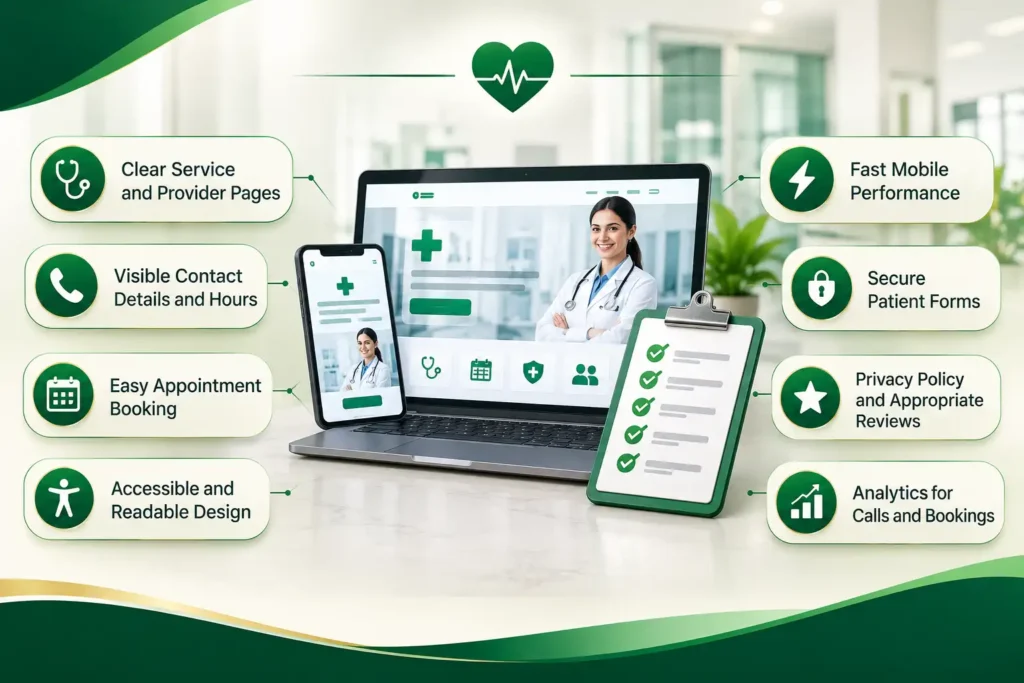
Use this checklist when you review a proposal or plan an in-house build:
- Clear service and provider pages written in plain language
- Visible phone number, address, and hours on every page
- Online booking or a simple request form
- Accessible design with readable contrast and keyboard navigation
- Fast load times on mobile connections
- Secure forms and a current privacy policy
- Reviews or patient testimonials that follow your industry’s rules
- Analytics that track calls, form submissions, and bookings
When to Plan a Healthcare Website Redesign
Consider a redesign when your site no longer reflects your services, loads slowly, looks dated on phones, or fails basic accessibility checks. A healthcare website redesign is also worth planning after a merger, a new location, or a major change in providers.
Do not redesign just because a new style is trending. Start with patient feedback, booking data, and performance reports. The goal is a site that gets more patients to the right next step.
Which Option Is Right for Your Practice?
A small practice with one or two locations often gets the best value from a medical website design company. The outside team brings specialist skills, and the practice avoids the cost of hiring a full team. A larger group with many locations and frequent updates may benefit more from an in-house team supported by outside specialists for major projects.
Ask yourself four questions: How often will the site change? Who will own the content? Who is responsible for security and compliance? What happens when something breaks at 9 p.m. on a Friday? The answers usually point clearly to one model or a hybrid.
FAQ
Hire designers if you need a focused project and have someone in-house to manage it. Choose an agency if you need design, development, content, and support in one place. For most practices, an agency offers more complete coverage, while individual designers can work well for smaller refreshes.
Yes. Any site that collects patient information should follow the privacy rules that apply to your practice and location. I am not a lawyer, so confirm your specific requirements with your compliance advisor or legal counsel. I can help with the technical side, such as secure forms, encrypted hosting, and clear privacy notices.
A focused practice site often takes six to ten weeks from planning to launch, depending on content readiness and approvals. Larger projects with many providers or locations take longer. Content delays are the most common cause of slow projects.
Costs vary widely by size, features, and whether you include ongoing support. Ask every provider for a line-item proposal so you can compare scope, not only totals. Budget for hosting, maintenance, and content updates after launch as well.
Final Thoughts
The right choice depends on your practice’s size, budget, and how much control you want. A medical website design company offers specialist skills and a faster start. An in-house team offers constant access and tighter control. Many practices find the best results in a blend of both.
If you are weighing these options, I can help you compare proposals and plan the next steps. I work with healthcare providers on clear, accessible websites that help patients find you and book with confidence.
- On this page
A clearer budget. A better store.
Your store deserves a solid plan.
Tell me what you’re building. I’ll send you a free, line-by-line estimate — without the guesswork.
- Free consultation and tailored quote
Fida Muhammad
Digital marketing expert and partner in business growth. I help businesses turn websites into measurable results through SEO, strategy, and conversion-focused design.
Let's build something that sells
Ready to plan your practice website? Get in touch for a free consultation.
Want to see the work behind this? Browse my portfolio for healthcare website projects.
